
Graphics extensions
This page lists the graphics extensions available in the ARM, ESP, and RISC-V versions of uLisp. The current releases of uLisp include built-in support for the graphics extensions with the displays on the following boards:
- Adafruit PyGamer and PyBadge (160 x 128)
- ESP32 boards with a TFT display (240 x 135)
- Adafruit Clue (240 x 240)
- Seeed Studio Wio Terminal (320 x 240)
- Sipeed MAiX RISC-V boards (320 x 240)
You could also use the graphics extensions with an external colour TFT display attached to a board via SPI, but you would need to do some configuration of uLisp to specify the type of display.
These extensions are based on and compatible with Adafruit's GFX library [1].
For examples of using these routines see Graphics utilities.
Summary
Plotting shapes
draw-pixel, draw-line, draw-rect, fill-rect, draw-round-rect, fill-round-rect, draw-circle, fill-circle, draw-triangle, fill-triangle
Plotting characters
draw-char, with-gfx, set-cursor, set-text-color, set-text-size, set-text-wrap
Display control
fill-screen, set-rotation, invert-display, display
Colours
Most of the plotting functions take a colour parameter to specify the colour of plotting. This is a 16-bit number specifying the red, blue, and green components of the colour:
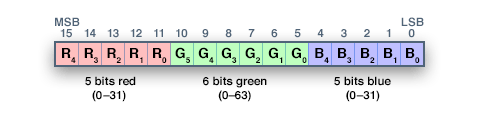
The following function rgb allows you to define a colour by specifying the red, green, and blue components as numbers between 0 and 255:
(defun rgb (r g b)
  (logior (ash (logand r #xf8) 8) (ash (logand g #xfc) 3) (ash b -3)))
For example, to define an orange colour you could write:
(defvar orange (rgb 255 127 0))
display function
Syntax: (display)
With monochrome OLED displays you need to call (display) to update the display from the memory cache after performing any drawing functions. Not needed with colour displays.
draw-char function
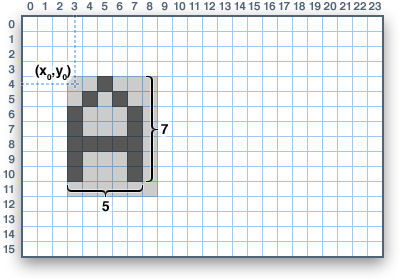
Syntax: (draw-char x y char [colour background size])
Draws the character char with its top left corner at (x, y). The character is drawn in a 5 x 7 pixel font in colour against background, which default to white and black respectively. The character can optionally be scaled by size.
Built-in character set
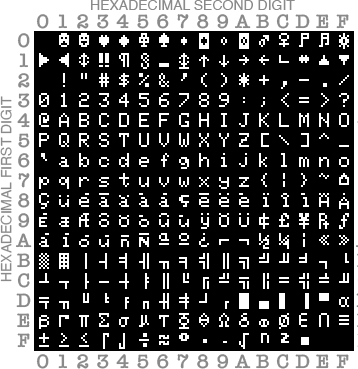
Text plotting uses a built-in character set which is based on the IBM PC Code Page 437 character set:
draw-circle function
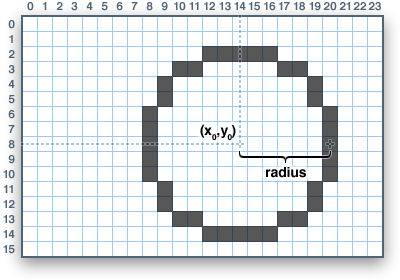
Syntax: (draw-circle x y r [colour])
Draws an outline circle with its centre at (x, y) and with radius r. The outline is drawn in colour, or white if omitted.
draw-line function
Syntax: (draw-line x0 y0 x1 y1 [colour])
Draws a line from (x0 , y0) to (x1, y1) in colour, or white if omitted.
draw-pixel function
Syntax: (draw-pixel x y [colour])
Draws a pixel at coordinates (x , y) in colour, or white if omitted.
draw-rect function
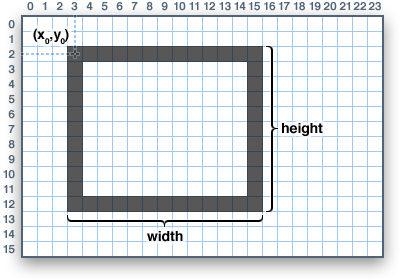
Syntax: (draw-rect x y w h [colour])
Draws an outline rectangle with its top left corner at (x, y), with width w, and with height h. The outline is drawn in colour, or white if omitted.
draw-round-rect function
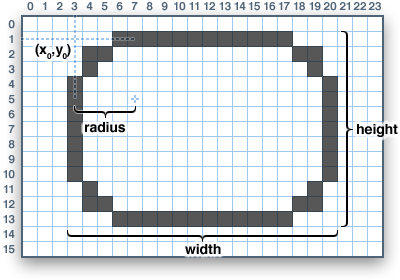
Syntax: (draw-round-rect x y w h radius [colour])
Draws an outline rounded rectangle with its top left corner at (x, y), with width w, height h, and corner radius radius. The outline is drawn in colour, or white if omitted.
draw-triangle function
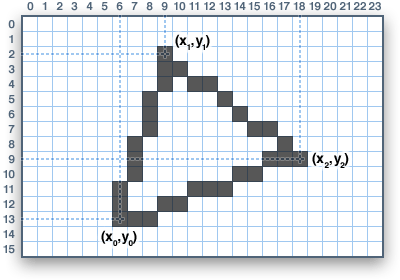
Syntax: (draw-triangle x0 y0 x1 y1 x2 y2 [colour])
Draws an outline triangle between (x1, y1), (x2, y2), and (x3, y3). The outline is drawn in colour, or white if omitted.
fill-circle function
Syntax: (fill-circle x y r [colour])
Draws a filled circle with its centre at (x, y) and with radius r. The circle is drawn in colour, or white if omitted.
fill-rect function
Syntax: (fill-rect x y w h [colour])
Draws a filled rectangle with its top left corner at (x, y), with width w, and with height h. The rectangle is drawn in colour, or white if omitted.
fill-round-rect function
Syntax: (fill-round-rect x y w h radius [colour])
Draws a filled rounded rectangle with its top left corner at (x, y), with width w, height h, and corner radius radius. The frame is drawn in colour, or white if omitted.
fill-screen function
Syntax: (fill-screen [colour])
Fills or clears the screen with colour, default black.
fill-triangle function
Syntax: (fill-triangle x0 y0 x1 y1 x2 y2 [colour])
Draws a filled triangle between (x1, y1), (x2, y2), and (x3, y3). The triangle is drawn in colour, or white if omitted.
invert-display function
Syntax: (invert-display boolean)
Mirror-images the display.
set-cursor function
Syntax: (set-cursor x y)
Sets the start point for text plotting to (x, y).
set-text-color function
Syntax: (set-text-color colour [background])
Sets the text colour for text plotted using with-gfx.
set-text-size function
Syntax: (set-text-size scale)
Scales text by the specified size, default 1.
set-text-wrap function
Syntax: (set-text-wrap boolean)
Specified whether text wraps at the right-hand edge of the display; the default is t.
set-rotation function
Syntax: (set-rotation option)
Sets the display orientation for subsequent graphics commands; values are 0, 1, 2, or 3.
with-gfx special form
Syntax: (with-gfx (stream) form*)
The with-gfx form evaluates the forms with stream bound to a gfx-stream.
You can then print text to the graphics display using the standard uLisp print commands. To control printing use set-cursor, set-text-color, set-text-size, and set-text-wrap.
For example, the following function pretty-prints the currently defined functions to the display:
(defun gprint ()
  (fill-screen)
  (set-rotation 2)
  (with-gfx (str)
    (set-cursor 0 0)
(pprintall str)))- ^ Diagrams reproduced from Adafruit under the Attribution-ShareAlike Creative Commons licence.